

A pale metal surface can be bright at the edge and dark inside an engraving. That contrast tells you about the light and the finish. To understand what the piece is made of, start with its material description.
Sterling silver specifies silver fineness: 925 parts per thousand, or 92.5% silver. A white-copper label does not state that silver content. Silver-plated copper describes a silver surface over a copper base. These descriptions answer different questions, even when the objects share a similar color.
Read the Material Before the Finish
Keep the material name attached to the object you are considering. Here is a useful starting point for reading a listing.
| Listing term | What it tells you |
|---|---|
| White copper | A material name in the listing; it does not specify 925 silver fineness or an exact alloy recipe. |
| Sterling silver / S925 | Silver of 925 fineness. Read any separately listed brass, stone or other components too. |
| Silver-plated copper | A layer of silver over copper, rather than a sterling-silver body. |
An antiqued or oxidized finish is a separate description. It does not establish silver content, an object's age or its place of origin.
The Birmingham Assay Office explains the 925 standard and the different parts of a UK hallmark. A stamped number and a complete independent hallmark are different things; a product photograph alone cannot establish assay results.
White-metal terminology also needs care. The Copper Information Center describes nickel silver as a copper–nickel–zinc alloy containing no silver. That is a useful distinction, but it does not establish the formula of every item sold as white copper. The AURA DEER white-copper listings discussed here do not give an exact composition or nickel content.
Two Cuffs: Material, Width and Fit
The Auspicious Cloud Open Cuff Bracelet is listed as white copper, 14 mm wide and 3 mm thick, with a stated wrist fit of 17–22 cm. The Vajra Open Cuff Bracelet, shown on the cover, is listed as S925 sterling silver, with an 18 mm cuff width and a 63 mm inner diameter. Its stated wrist fit is also 17–22 cm.

The common fit range does not make their forms identical. The 18 mm cuff presents a broader surface than the 14 mm cuff. Consider where the ends sit, how the cuff meets a sleeve and whether it allows comfortable movement. Keep those questions separate from silver fineness. For the Vajra cuff, the listing advises gentle adjustment and avoiding repeated excessive bending.
Read Every Material in a Mixed Piece
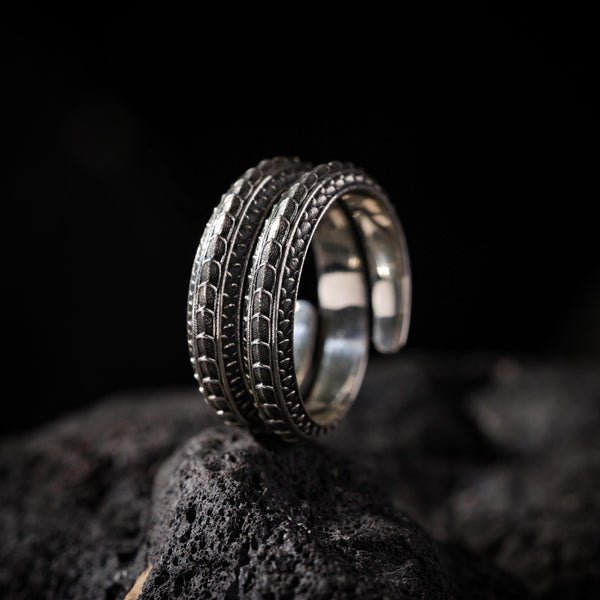
The Crossed Vajra Pendant Necklace is listed as silver-plated copper with brass details, turquoise and red agate accents. It should be read as a plated, mixed-material piece. The Dragon Scale Adjustable Ring lists sterling silver and brass. Its sterling-silver description does not turn the separately named brass into silver.
A simpler material list still leaves other choices to make. The Kui Dragon Faceted Rolo Chain Necklace is listed as white copper with an antiqued finish, a 4 mm chain width and lengths from 55 to 75 cm. Look at the link size and hook-and-ring closure as well as the material name.

Choose With the Information You Need
If a specified silver fineness matters to you, begin with a sterling-silver listing and read its component details. If you are drawn to a particular white-copper form, assess its dimensions, closure and finish without treating its pale color as a silver claim. When a particular metal must be avoided, obtain composition information before buying; neither a color nor these labels alone answers every skin-contact question.
Care also follows the whole piece. Start gently, and confirm its materials and finish before using metal polish or a dip. Our material-by-material care guide explains that first step. For a closer look at silver surfaces and forms, read Silver: The Metal That Has Always Known Where It Belongs.
A clear material description makes room for a more personal choice: the weight of a cuff, the scale of a link, the object you reach for again. The Keeper considers the care that follows.