

Table of Contents
- What is tactile grounding, and why it works
- Practice 1: Before high-stakes moments — anchor your stance
- Practice 2: When thoughts spiral — steady scattered energy
- Practice 3: Before rest — set down unspoken worries
- Making the practice your own
Tactile grounding is a well-documented technique used in somatic therapy and trauma-informed care, which uses physical touch to pull attention out of racing thoughts and back into the body. It requires no training, no quiet space, and no belief system — just a tangible object to focus on.
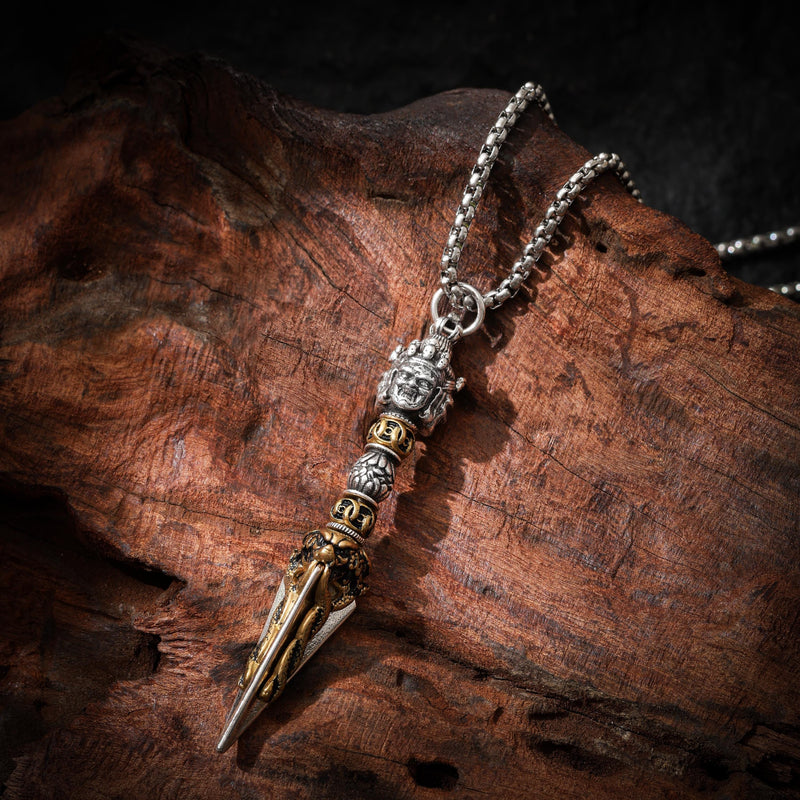
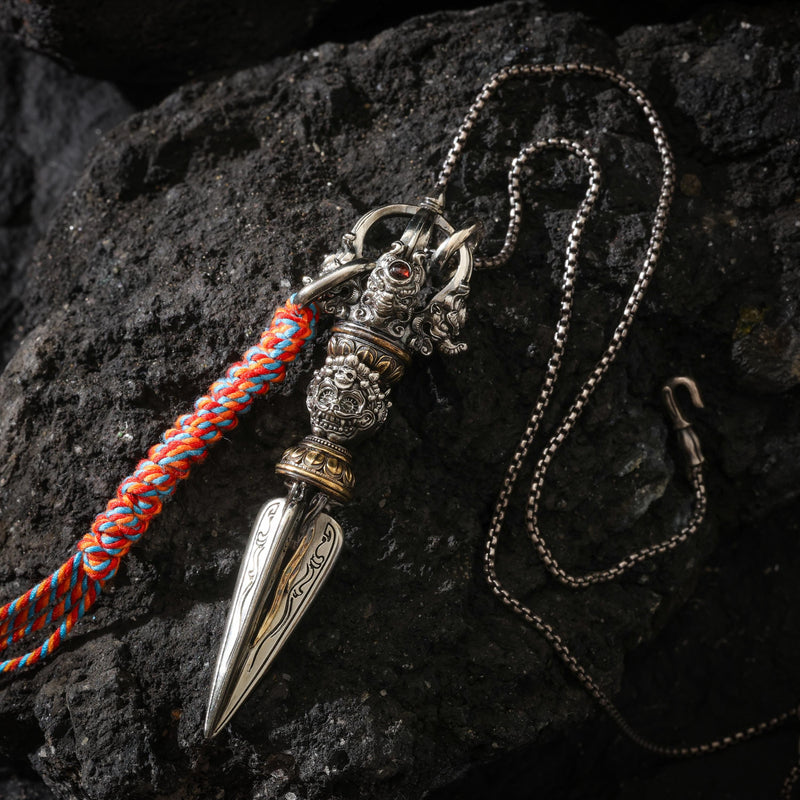
In this guide, we pair that evidence-based mechanism with the Tibetan phurba pendant: a symbol long associated with stability, inner boundaries, and anchoring unsteady energy. This is not a religious ritual, and the pendant holds no inherent power. Its value lies in its solid weight, defined three-sided shape, and the meaning you assign to it — together, they create a portable, always-available anchor for the chaotic moments of everyday life.

What is tactile grounding, and why it works
When you feel overwhelmed, anxious, or swept up in anger, your brain enters what psychologist Daniel Goleman named the amygdala hijack. The amygdala — the brain’s primitive threat detector — triggers a stress response before signals reach the prefrontal cortex, the region responsible for rational thought, impulse control, and measured decision-making. In this state, trying to “calm yourself down” with thoughts alone almost always fails.
Tactile grounding interrupts this cycle. By deliberately focusing on a physical sensation against your skin, you activate the body’s parasympathetic nervous system through pressure and touch receptors. This sends a direct signal of safety to the brain, pulling you out of abstract worry and back into the present moment. Clinical practice widely uses this approach for acute anxiety, emotional dysregulation, and post-stress reset, because it bypasses overactive thought loops and speaks directly to the nervous system.
The phurba is uniquely well-suited for this work:
- Its solid metal weight and cool temperature create strong, clear sensory feedback, stronger than smooth or soft objects.
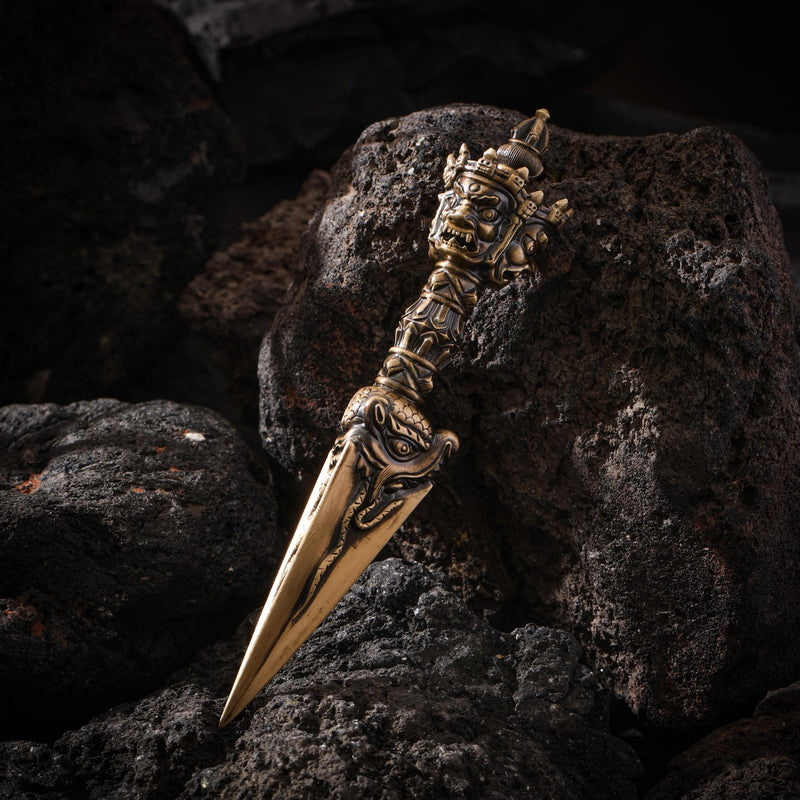
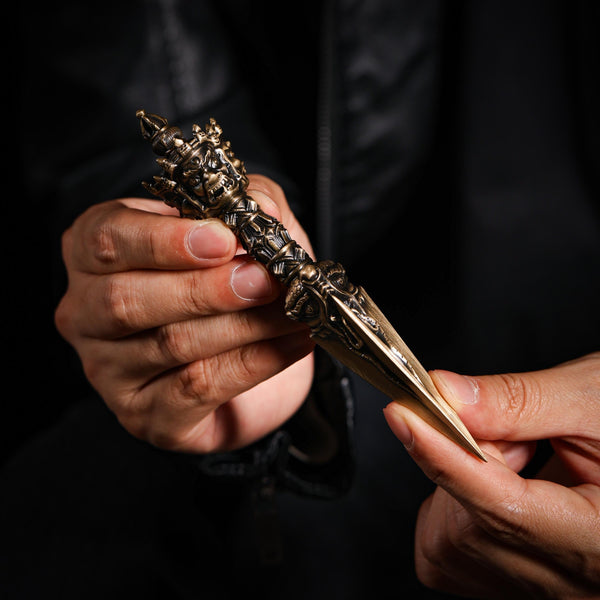
- Its distinct three-edged shape gives your fingers a defined texture to trace, making it easier to hold focused attention.
- Its symbolic association with stability and rooted boundaries reinforces the psychological effect through meaning — a well-documented principle of symbolic psychology, where objects with personal or cultural significance amplify intention.
It is not the pendant itself that calms you. It is the act of touching it, and the meaning you bring to it, that resets your nervous system.
Practice 1: Before high-stakes moments — anchor your stance
Best for: Important meetings, negotiations, difficult conversations, public speaking, or any moment you tend to shrink, second-guess yourself, or get swept up in other people’s expectations.
Entering high-pressure situations while already unsteady means you will likely react to the room, rather than act from your own judgment. This practice lets you calibrate your state first, so you can show up aligned with what you actually want to say.
How to do it:Before you walk in, wrap your fingers lightly around the pendant. Trace the full length of the three-sided blade slowly, from top to tip, as you take two to three slow, deep breaths.
As you finish tracing, silently name the stance you want to carry with you — for example, “I stand my ground” or “I speak with clarity.”
Feel the weight of your feet on the floor, then step forward.
This works because it pairs a physical sensory cue with a clear intention, priming your nervous system for agency before you face pressure. The phurba’s sharp, directed shape acts as a sensory metaphor for focus: it cuts through the noise of self-doubt, and anchors you to the position you already know you want to take.
You do not need to be the loudest or most confident person in the room. You just need to be present, and rooted in your own judgment.

Practice 2: When thoughts spiral — steady scattered energy
Best for: Moments of emotional overwhelm — after harsh feedback, during conflict, when stuck in rumination over past mistakes, or when future anxiety feels unmanageable.
When thoughts spiral, they feed on themselves. One worry leads to ten more, and within minutes you can feel completely unmoored. Trying to “stop thinking” only makes the loop louder. What works instead is giving your brain something physical to focus on.
How to do it: Close your palm fully around the pendant. Squeeze just firmly enough to feel its weight, the edges of the blade, and the temperature of the metal against your skin.
Hold your attention there: notice if it feels cool or warm, smooth or textured, heavy or light. If your mind drifts back to worries, gently guide it back to the sensation in your hand.
Stay with the touch until you feel the edge of the panic soften, and you have enough space to choose your next step.
This is a simplified form of the 5-4-3-2-1 grounding method used by therapists worldwide. Instead of naming five things you see, four you hear, and so on, you use one strong tactile anchor to pull you back to the present. It is discreet, invisible to anyone around you, and works anywhere.
The phurba does not make the problem disappear. It creates a small gap between the trigger and your reaction — enough space so you can respond intentionally, instead of acting from impulse or fear.

Practice 3: Before rest — set down unspoken worries
Best for: Nights when you lie down and your brain immediately starts replaying the day, listing tomorrow’s tasks, or cycling through worst-case scenarios, making it hard to fall asleep.
Anxious insomnia thrives on the feeling that you have to “hold onto” every worry, or you will forget to deal with it tomorrow. Your brain keeps looping not because the problems are unsolvable, but because it does not trust they will still be there when you wake up. Giving those worries a physical place to live lets your mind let go.
How to do it: Set your phurba pendant on the nightstand, within arm’s reach.
Rest one fingertip on the tip of the blade. Feel its solid, fixed shape — a steady, unchanging point in the dark.
Silently say to yourself: Everything that is unfinished, everything that is unanswered, can wait here until morning. I do not have to carry it tonight.
Take one slow breath, remove your finger, and turn to rest.
This draws on a cognitive behavioral therapy (CBT) technique called thought externalization. When you assign abstract worries to a tangible object, you signal to your brain that the thoughts are being held somewhere safe — they do not need to circle in your head all night. The phurba’s stable, unshakable symbolism strengthens that sense of safety.
You do not have to solve anything tonight. You just have to set it down, and come back to it when you are rested.

Making the practice your own
There is no “right” way to use your phurba as a grounding tool. The only rule is that it works for you. A few notes to help you build the habit:
- You do not need to follow exact movements. Trace it, squeeze it, hold it between your thumb and forefinger — whatever feels most natural in the moment.
- Use it casually, not only in crisis. Every time you touch your pendant throughout the day, take one breath with it. Over time, this builds a conditioned response: simply feeling it against your chest will trigger a small sense of calm.
- It is not a replacement for professional care. If you are living with chronic anxiety, trauma, or persistent emotional distress, this practice is a complement to support from a licensed therapist or healthcare provider, not a substitute.
At AURA DEER, we often talk about talismans as daily armor. That does not mean they protect you from hard things. It means they give you a reliable point to return to, when hard things come.
The phurba will not remove chaos from your life. It will not make difficult conversations easy, or erase worry entirely. What it will do is give you something solid to hold onto — a small, tangible anchor — so you can stay steady, even when everything around you feels unsteady.
It is not the pendant that gives you stability. The stability is already in you. The phurba is just the quiet reminder of how to find it.
You’ve heard all the standard advice. Breathe deeply. Meditate for 10 minutes. Step away and reset. But when you’re in the thick of a spiraling mood, 10 minutes feels impossible. You don’t have time for a full grounding practice. You don’t have the bandwidth to walk yourself through a workbook exercise. You need 3 seconds.
That’s the core of this ritual. It’s not a spiritual practice. It’s not a lucky charm. It’s a simple, tactile psychological tool — built for ordinary people navigating noisy, overwhelming modern lives. You don’t need any prior knowledge, any belief system, any training. All you need is the phurba pendant resting against your chest, and 3 seconds to come back to yourself.
The three-sided blade is not a weapon. It’s an anchor. Sharp, defined, and solid to the touch, it gives your racing mind a single, tangible point to focus on — pulling you out of chaotic thoughts and back into your body, almost instantly.